We built the assessment we wished existed when AI arrived.
GrowthUP Partners built the AI Personality Assessment on one belief: AI should amplify human judgment, not replace it. Understanding how you are wired is how you stay in the driver's seat.
A personality framework built for the AI moment.
Most personality frameworks were built for a different era. They describe how you are in general, which is valuable, but they were not designed for a moment where every organization is being asked to adopt a technology that some people find thrilling and others find threatening, and both of those reactions are completely reasonable.
The AI Personality Assessment focuses on the one thing those frameworks miss: how your particular wiring shows up specifically when AI enters the room. What questions do you bring? What risks do you protect against? What opportunities do you reach for first?
Those patterns are real. They are measurable. And knowing them, for yourself and for your team, is how you turn the noise of AI adoption into something you can actually work with.

Where understanding your AI instincts changes things.
The wiring that shapes how you adopt AI shows up everywhere AI touches your work. Here is where it matters most, and how the assessment helps.
AI adoption and rollouts
Build a shared, practical way to decide how and where AI gets integrated, responsibly and at a pace your people can actually absorb. Decades of change research point to the same conclusion: adoption succeeds or fails on people, not features.
How the assessment helps: it shows you who is ready to pilot, who needs proof first, and who will quietly resist, so you can sequence a responsible rollout around real readiness instead of an org chart.
93% of AI investment goes to technology. Only 7% goes to people.Deloitte Tech Trends 2026 and HCLTech, 2026
Take the testHiring and team building
Bring the right mix of instincts into the room as AI reshapes roles. Research on team performance is consistent: cognitively diverse teams make better and more resilient decisions than teams that all think alike.
How the assessment helps: it reveals where your team is overweight, all enthusiasm and no caution, or all caution and no momentum, so you hire and develop for the perspective you are missing.
Teams that use AI as a true teammate are three times more likely to produce top 10 percent quality ideas.Harvard Business School and Stanford AI Index 2026
Take the testProductivity
Turn AI from a tool people are told to use into one they actually use. Self-awareness research links understanding your own working style to higher engagement and better follow through.
How the assessment helps: it points each person to the AI habits that fit how they already think and work, so the tools get adopted and kept instead of dropped after week two.
Productivity is 40% higher at the companies most exposed to AI.PwC 2026 Global AI Jobs Barometer
Take the testMorale and trust
Protect morale by naming the very real fear AI brings to identity and livelihood before it hardens into quiet resistance. Decades of organizational research tie psychological safety to whether people speak up or shut down.
How the assessment helps: it gives that fear a shared, neutral language, so the real concern surfaces in week one instead of becoming disengagement in month six.
56% of people at future-ready organizations say AI gives them more chances to learn and grow, compared to just 16% globally.Adecco, Leading in the Age of AI
Take the testA shared language
Experience a simple, practical vocabulary for how and where AI can be integrated responsibly, and for bringing very different people together around it. A common language is one of the most studied levers for lowering conflict on a team.
How the assessment helps: it turns a personal standoff into the Guardian's question meeting the Catalyst's energy, both doing their job, so disagreement gets less heated and far more useful.
40% of leaders name coordinating across cross-functional teams as a top barrier to AI.World Economic Forum, Future of Jobs 2025
Take the testThe science, in plain language.
The assessment is grounded in the Big Five, the most studied and replicated model in personality science, and informed by frameworks like the Enneagram and DISC. Unlike letter type systems, the Big Five measures personality on continuous scales rather than sorting people into rigid boxes, so results are more stable and more nuanced.
We layered the Law of Diffusion of Innovation on top, the framework that describes how new technologies move through a population. Mapping those two things together gives us the eight types: each one is a real combination of measurable traits and a real position on the AI adoption curve.
The three dimensions we measure are plain enough to explain without jargon. How curious are you? How much do you rely on structure? And when change arrives, do you process it out loud with others, or work it through on your own first? Your position on each of those three spectra is what determines your type, and each score is built from many questions so no single answer can flip it.
Built by people who live in this work.
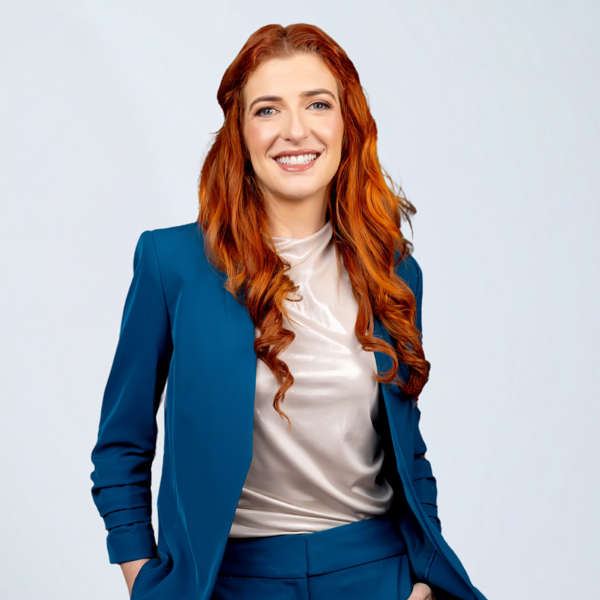
The original AI Personality Assessment was co-created by Abigail Merrill of GrowthUP Partners and Rachel Anderson of The Human-Centric Leader. Here is what each of them brought to it.
Abigail Merrill
Abigail is an AI change management consultant who helps organizations move from AI anxiety to AI adoption. She built GrowthUP Partners on the belief that the human side of AI is where the real work is. The assessment came out of the patterns she kept seeing in client work: people were not struggling with the technology, they were struggling with themselves and each other. She built the assessment itself, including the three dimensions, the eight types, the 36 questions, the scoring model, and the team workshop.

Rachel Anderson
Rachel is a Prosci-certified change management practitioner and leadership development expert. She founded Human-Centric Leader to help organizations navigate change by keeping people at the center. She shaped the assessment's foundation: that your results should speak to you as an individual, at work and at home, that a team needs every type present to stay in balance, and that Rogers' Law of Diffusion of Innovation belonged at the center of the model.
No wrong types. No good or bad. Just honest.
No wrong answers. The assessment is not a test of AI fluency. It describes how you are wired, not how you should be wired.
Every type is essential. A team of only Champions is as exposed as a team of only Skeptics. The diversity of types is the point.
Types are a starting point, not a ceiling. Most people carry more than one type depending on context, and your result can shift as you grow.
AI should amplify human judgment. The goal of the assessment is not to optimize people for AI. It is to help people understand themselves, so they can stay in the driver's seat.